
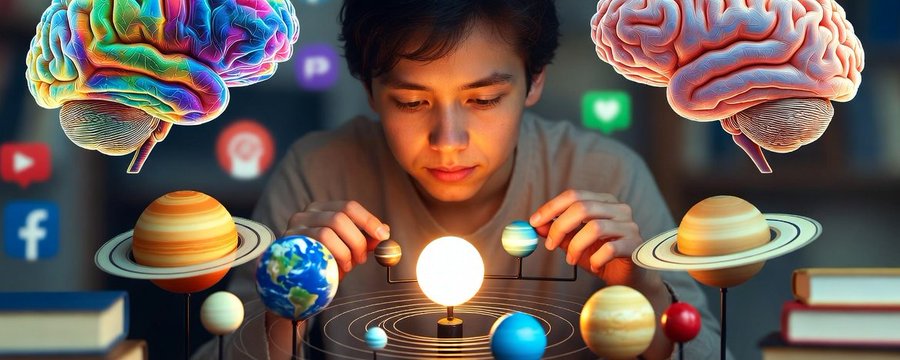
Check Your Models
Arguably, 90% of everything you know was learned secondhand. I mean, you don’t have direct knowledge and can’t really confirm with certainty that it’s true.
For example, there are 8 (maybe 9, haha) planets that orbit the sun in our solar system. Everyone knows this. I’ve never seen the planets orbit the sun. Have you? And what’s with this 8 versus 9 planets debate?
The Wet Computer
The human brain has been called a wet computer. It has deeper structures called the limbic system. The limbic system is the “firmware” of our wet computer. It comes preprogrammed with human instincts (emotions) like fear, love, hate, joy, etc. We are all born with pretty much the same programming.
The brain also has an outer layer called the neocortex. The neocortex is largely undeveloped at birth. It is highly programmable. This is where everything we learn is stored.
How Do We Know Anything Is True?
So, how do we have any hope of knowing that 90% of our knowledge holds any truth? We build models in our minds.
Back to the example: I have an image of the 8 planets orbiting the sun—a model. We have all sorts of models—really hundreds, if not thousands. Some we’re aware of, and some we’re not. You have a model for how your life should go.
Some models you build yourself, and some are programmed into you… without your awareness. Information comes to you through social media, other people, television, books, the five senses, etc.
The Model Trap
Now, back to judging new information. When some new bit of knowledge comes to us, we try to fit it to one of our internal models:
- If it fits: “That makes sense—it must be true.”
- If it doesn’t fit: “That’s false.”
But there’s another possibility: What if your model is wrong?
If the new information doesn’t fit and you dismiss it as false, it could actually be true—and your model flawed. Conversely, if it fits your model but the model is wrong, the information could be false.
How Often Do We Check Our Models?
Truthfully, most people almost never do. We’ve all seen it—people twisting themselves into logical pretzels to maintain their internal model in the face of irrefutable facts that don’t fit.
The problem is that many people equate their models with their self-identity. So when something threatens those models, it feels like a personal attack.
The Purpose of Models
But remember, the purpose of your internal models is to help you evaluate secondhand information—the stuff that can’t be directly verified. Good models must represent external reality faithfully, so you can not only evaluate new information correctly but also predict outcomes.
When you receive new information that disrupts your model, don’t let it scramble you. This is an opportunity to check your model. When you adjust your scrambled model into a new, cohesive, internally logical one that fits all the facts, you gain wisdom.
Wisdom is literally just really good models.
So check your models and look for opportunities to improve them.